
Last month, a federal court in Minnesota dismissed an invasion of privacy lawsuit brought by former Minnesota Vikings offensive tackle Matt Kalil against his ex-wife, former beauty queen and current social media influencer Haley Kalil. Kalil v. Kalil, 0:26-cv-00062 (D. Minn. 2026). The lawsuit alleged that Haley violated Matt’s privacy by publishing a lurid description of his penis to her millions of followers on social media.
Under state law, to be actionable, an invasion of privacy claim requires that the defendant gave publicity to a matter concerning the private life of the plaintiff, if (1) the matter would be highly offensive to a reasonable person, and (2) it is not of legitimate public concern. Lake v. Wal‐Mart Stores, Inc., 582 N.W.2d 231, 233 (Minn. 1998).
In Kalil v. Kalil, the court issued the ridiculous ruling that “Haley’s comments about Matt’s penis… were about her life, her marriage, and her divorce, all of which are topics about which her millions of followers have a legitimate interest,” because she and Matt are celebrities.
This is an absolutely perverse and indefensible ruling. In fact, it is so far beyond parody that it undermines the dignity of the court itself. That a federal judge is unable to tell the difference between Haley Kalil’s life and Matt Kalil’s penis is just pathetic. But the application of ridiculously high pleading standards to speech tort cases is nothing new. It began in 1964, with a U.S. Supreme Court decision in a case called New York Times Co. v. Sullivan.
The Sullivan Precedent Protects Defamatory Speech
Speech torts are civil claims in lawsuits that allege misconduct based on speech. They include defamation, invasion of privacy, and tortious interference with contract. Defamation is the most well known. Defamation occurs when another person spreads falsehoods about you that damage your reputation. Defamation can (and often does) destroy businesses, relationships and careers.
In Sullivan, the Supreme Court constitutionalized defamation law for the first time. Before Sullivan, defamation was unprotected by the First Amendment. It was defined by state law, and most states did not require plaintiffs to show that a defendant intended to lie. All that was needed to show defamation was the publication of a damaging falsehood, whether intentionally or not. Obviously, this incentivized the media to ensure accuracy in reporting the news.
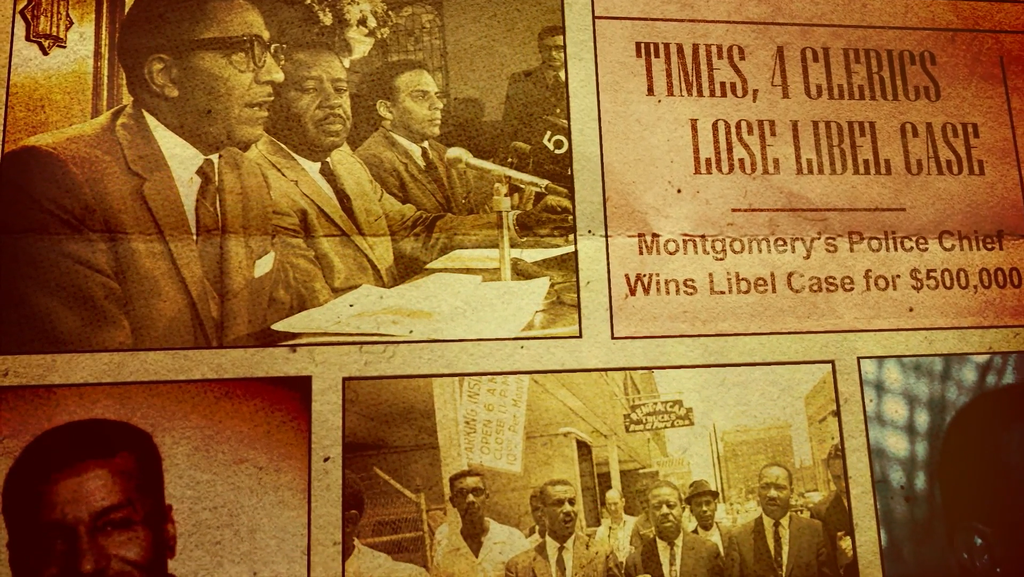
In 1960, the New York Times ran a full-page ad from a civil rights organization that criticized the Montgomery, Alabama police for their treatment of civil rights activists. The ad contained numerous material falsehoods. Based on those falsehoods, Montgomery police commissioner L.B. Sullivan sued the Times for defamation in Alabama state court. The jury returned a verdict in favor of Sullivan and awarded him $500,000 in damages. The Times appealed first to the Alabama Supreme Court, which affirmed the verdict, and then to the U.S. Supreme Court.
The U.S. Supreme Court reversed, holding that the First and Fourteenth Amendments “require a federal rule that prohibits a public official from recovering damages for a defamatory falsehood relating to his official conduct unless he proves that the statement was made with ‘actual malice’—that is, with knowledge that it was false or with reckless disregard of whether it was false or not.” New York Times Co. v. Sullivan, 376 U.S. 254, 279–80 (1964).
Quoting an earlier decision from the Kansas Supreme Court, the Sullivan court noted that, “this privilege extends to a great variety of subjects and includes matters of public concern, public men, and candidates for office.” Indeed, in the years since Sullivan, the Supreme Court explicitly expanded the privilege to apply not just to government officials, but to all public figures—defined not only to include household name celebrities, but virtually anyone who speaks out on a public controversy.
Why Sullivan Must Be Revisited
Sullivan made it almost difficult to win a speech tort case involving a matter of public concern, leading to the perverse and indefensible outcome we just saw in Kalil v. Kalil. Before Sullivan, robust civil liability for defamation encouraged truthfulness in public discourse. After Sullivan, journalists and other publishers were free to destroy reputations and livelihoods without first checking the facts.
Because journalists are its natural beneficiaries, Sullivan has been the subject of a great deal of hagiography, and major news outlets tend to clutch their pearls whenever the “actual malice” standard is criticized. Indeed, the Sullivan court itself couched its ruling as part of “a profound national commitment to the principle that debate on public issues should be uninhibited.” 376 U.S. 254, 270.
In recent years, four high-profile defamation plaintiffs have petitioned the Supreme Court to hear appeals that, if granted, would require the court to revisit Sullivan. While the court denied certiorari in all of these cases, Justice Thomas wrote separately in three of them (filing two concurrences and one dissent), arguing that,
[Sullivan] and the Court’s decisions extending it were policy-driven decisions masquerading as constitutional law…. We should not continue to reflexively apply this policy-driven approach… From the founding of the Nation until 1964, the law of defamation was ‘almost exclusively the business of state courts and legislatures.’ But beginning with [Sullivan] the Court ‘federalized major aspects of libel law by declaring unconstitutional in important respects the prevailing defamation law in all or most of the 50 States.’
McKee v. Cosby, 586 U.S. 1172, 1173 (2019) quoting Gertz v. Robert Welch, Inc., 418 U.S. 323, 369-370 (1974) (White, J., dissenting).
Even if you subscribe to Justice Thomas’s strict originalism, it must be conceded that for a generation, Sullivan and its progeny were defensible because they acted as a shield for the fourth estate in a relatively stable marketplace of ideas. But today, technology has withered the fourth estate, and the marketplace of ideas is an open-air insane asylum.
Today, more than half of American adults are functionally illiterate, meaning that they read at or below a sixth grade level and would have trouble parsing their utility bill. As many as 10% of Americans believe the moon landing was faked. Polls show that over 20% of Americans (and 40% of young adults) have favorable views of Luigi Mangione, the assassin of United Healthcare CEO Brian Thompson. Over twenty percent of Americans harbor extensive antisemitic prejudices. Massive voices like Joe Rogan validate grifters like Ian Carroll , who enjoy huge followings on social media while disseminating lunatic conspiracy theories, like blaming Erika Kirk for the assassination of her late husband. Indeed, twelve percent of Americans, and 22% of young adults, believe the assassination of Charlie Kirk was justified.
This is not a marketplace of ideas. It is a marketplace of abysmal cynicism and dementia. That is what the Sullivan “actual malice” standard is protecting. No one can deny that in the era of social media, incentives around public speech are sorely in need of reform. Robust civil liability for defamation encourages truthfulness in public discourse, and discourages dishonesty. That is why Sullivan must be revisited and overturned by the Supreme Court as soon as possible.
Late Night Law® is a dedicated defamation, privacy and social media law firm. If you are the target of doxxing, defamation or cyberstalking in New Mexico, in Washington, or in Texas, contact us at (505) 225-2623 to schedule a free consultation with a defamation attorney today.
This article is not legal advice, and does not create an attorney-client relationship between the reader and Late Night Law. Please consult an attorney for individualized advice if you have a legal matter.
All text content © Late Night Law 2025-2026.